



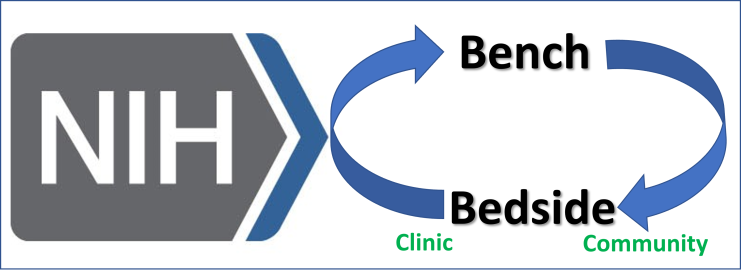
The NIH Bench-to-Bedside and Back Program (BtB) is a two-year awards program originally established in 1999 to integrate the work of basic and clinical intramural scientists and expanded in 2006 to partnerships between intramural and extramural programs. Intramural science refers to research that takes place on an NIH campus under the auspices of federal employees, while extramural research is conducted by investigators and institutions outside of NIH. These awards are viewed as seed awards for new translational research projects reflecting partnerships between basic and clinical investigators, many of which led to larger awards with expanded scientific aims. The bedside component encompasses clinical activities, and applicants can also propose studies impacting community health.
In its more than two and a half decades of existence the NIH BtB Program has helped initiate many important laboratory/clinical collaborations involving NIH scientists and clinical investigators with each other and with many external institutions. In its current administrative structure, run by the NIH Office of Clinical Research Education and Collaboration Outreach with funds from the Office of the NIH Director, our funding partners and occasionally the NIH Institutes and Centers, the BtB Program emphasizes the following aspects of its goals as exemplified by its reviews of applications:
- To promote robust multi-directional collaborations among laboratory ("bench") and patient-focused ("bedside") investigators.
- To facilitate initiation of new and imaginative research programs targeting important medical questions, including specialized queries whose elucidation may have broad implications for understanding normal function and the pathophysiology of individual and community health issues.
- To investigate problems identified by studies of patients with diverse diseases or results from cell or animal studies that can likely be extended to clinical studies, within the scope of the proposal or shortly thereafter.
- To investigate problems identified by studies of patients with diverse diseases or results from cell or animal studies that can likely be extended to clinical studies, within the scope of the proposal or shortly thereafter.
- To allow investigators to move into new fields or broaden their approaches in ways not easily supported by their current funds for ongoing research, including especially NIH-wide projects and external collaborations.
- To optimize the use of the specialized facilities at the various NIH campuses, including especially the NIH Clinical Center.
Although individual projects may occasionally be approved that do not fully meet all these criteria, most projects that have been funded in the past have been within this framework.
- Funded projects can receive up to $150K per year for two years. Projects can involve only intramural investigators, but collaborations between intramural and extramural investigators are encouraged with no impact on the scoring process.
- Intramural investigators in all institutes/centers are eligible to serve as project leaders on proposals. All Bench-to-Bedside and Back Program (BtB) teams should involve an intramural investigator PLUS one or more investigator(s) from another institute and/or an extramural partner(s).
- For awards involving extramural partners, extramural funds will be as awarded via an administrative supplement to an existing NIH grant. For additional information and requirements please see the 'Information for Extramural Investigators.'.
Contact Us
(301) 402-6313